JB to Singapore: Every Way to Cross, Honestly Compared
Published on October 2, 2026·5 min read
Bus, car, motorbike or the Second Link — what each way across the Causeway costs and how reliable it is, and the Singapore VEP rising in 2027.

Bus, car, motorbike or the Second Link — what each way across the Causeway costs and how reliable it is, and the Singapore VEP rising in 2027.
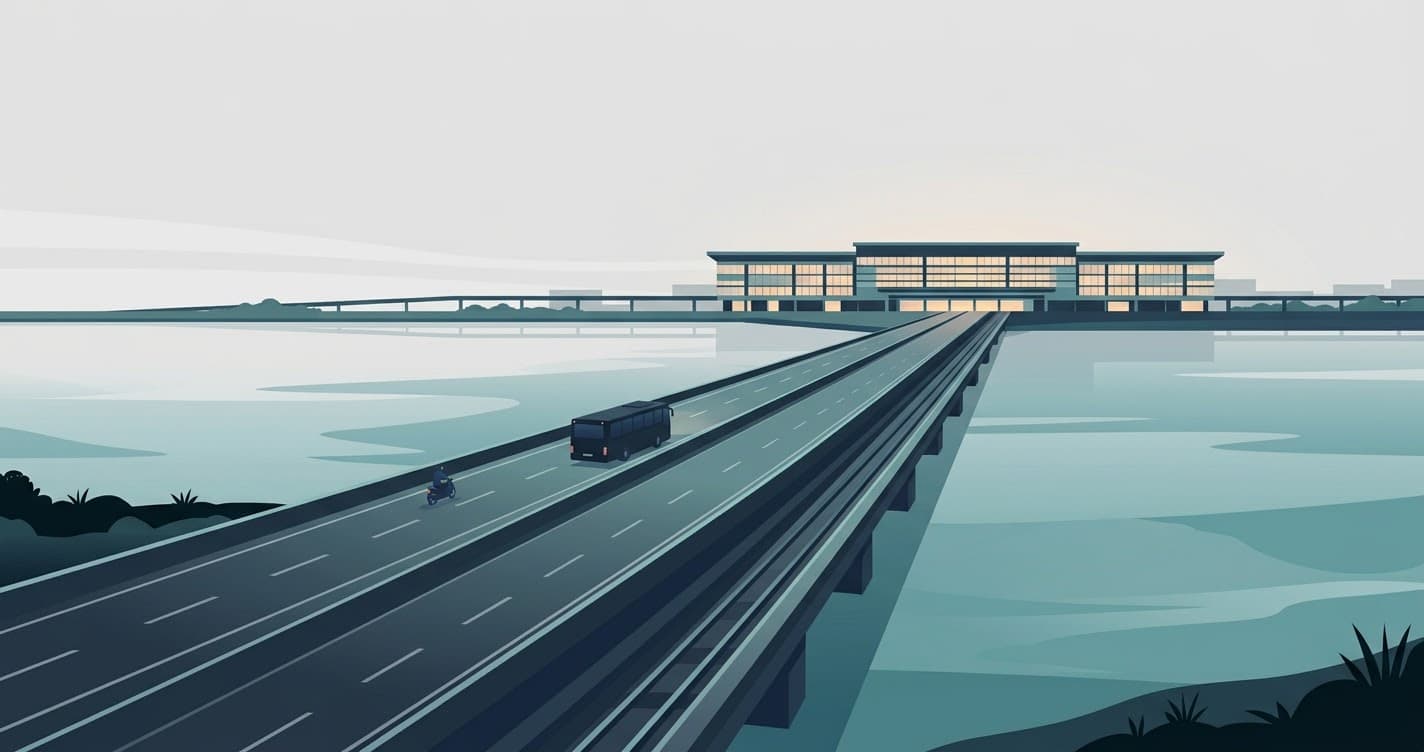
Four ways across the border work right now, and a fifth is being built.
The fifth, the RTS Link train, comes further down. It is not a crossing you can use yet.
These are the figures that come out of a Malaysian driver's pocket going into Singapore.
Malaysia also collects a toll at the Bangunan Sultan Iskandar plaza on the JB side, taken electronically by Touch 'n Go or RFID.
One change is coming that a daily driver should plan around now. From 1 January 2027 the Land Transport Authority raises the VEP to S$50 a day for a car and S$7 for a motorcycle, and removes the 10 free days and the free weekday hours — it stays free only on weekends and Singapore public holidays. For someone crossing by car every weekday, the VEP stops being an afterthought and becomes one of the larger lines in the monthly commute budget.
Cost is only half the commute; the other half is time, and time on the Causeway is the part you cannot fix. Around 350,000 people cross here each day — the busiest land border crossing anywhere — and on the heaviest days it climbs well past 400,000. Singapore's Immigration & Checkpoints Authority recorded 408,000 crossings in a single day on 3 July 2023, against an average of about 367,900 a day over that week. Weekday mornings and evenings, Friday nights, the eve of a public holiday: that is when a crossing of a few minutes off-peak stretches into hours.
That unpredictability is the real tax on the commute. You can budget the tolls and the permit; you cannot budget a jam. It is also why the way you cross matters — a motorcycle or a bus is not held behind the car queue in the same way a car is.
A rail crossing is being built: the RTS Link, between Bukit Chagar in JB and Woodlands North in Singapore. It is under construction and not yet carrying passengers, so it is not a crossing you can use today. When it does run it adds a train that skips the road queue outright — but the date it begins service is not something to bank on.
What matters for a home decision is where the station sits: it is being built at JB Sentral, beside the existing CIQ. A home close to that point is close to the train whenever it arrives, and close to everything that already runs in the meantime.
Whichever way you cross, the walk to the starting line is the one variable you control. One Heritage is a filed 140 m from the CIQ and the RTS terminal at JB Sentral — out of the lobby, across Jalan Trus, and you are at the hub. You are not driving across town to join the queue; you start at it. City Square is 30 m away, Komtar JBCC 100 m.
That does not shorten the queue or lower the VEP. What it removes is the trip before the trip — the drive-and-park that eats the first half hour of a causeway commute before you have crossed anything. Here is what that 140 m looks like on the ground.
Discover more insights and updates about our premium development
A dual-key unit is one title split into two lockable spaces. Which One Heritage layouts convert, what each one gives you, and who the split actually suits.
Published on September 30, 2026 · 6 min read
One Heritage is a filed 140 m from the CIQ / RTS at JB Sentral. What that distance really means, and why the station timetable is a separate question.
Published on September 28, 2026 · 4 min read